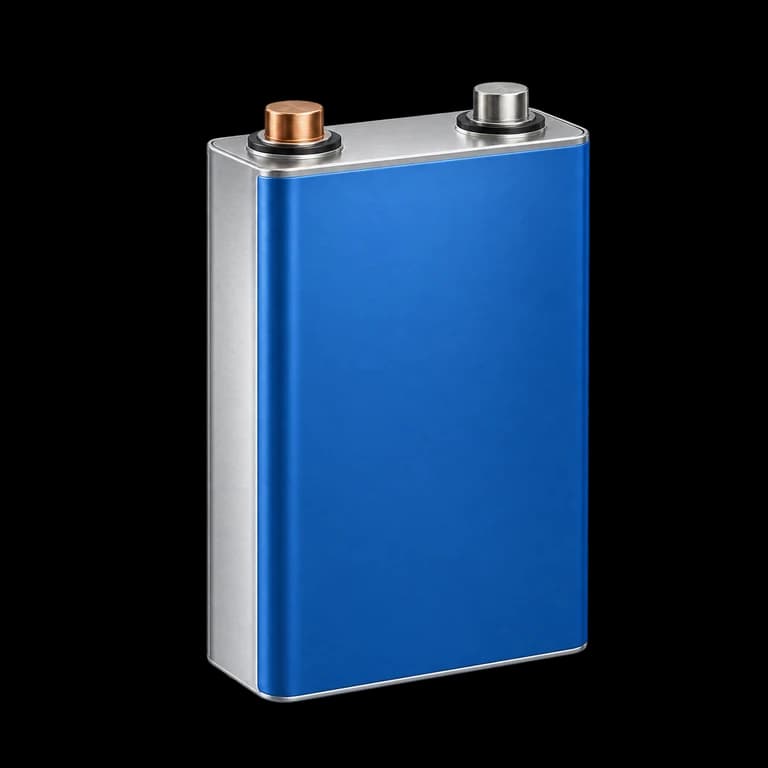
Highstar NaCP50160118-70E3
Highstar NaCP50160118-70E3 prismatic sodium-ion cell. Nominal capacity 70 Ah; nominal voltage 3.05 V; main voltage window 1.8-3.95 V. Width 160 +/-0.8 mm and thickness 50.1 +/-1.0 mm; height is not stated in the main table and is left unspecified. Weight 1.8 +/-0.2 kg. The 3C rating is a 30-second pulse, so no continuous amperage is asserted. >=2000 cycles at 25 +/-2 C, 0.5C/0.5C, 3.9-2.0 V to 80% retention under 200 +/-20 kgf preload. Revision A is dated 2023.03.
Capacity
70Ah
Chemistry
Sodium-ion
Format
Prismatic
Weight
1.8kg
Specification
Engineering parameters
Core fields 3/4 · 0 individually confirmed fields
Coverage counts capacity, voltage, dimensions and weight; it does not certify the model. Missing fields are not zero. Expand each metric to inspect its conditions and evidence.
Conditions & source
存储温度 Charging :-20° C-55° C, 65%± 20%RH 充电:-20° C-55° C,65%± 20%RH 3.7 Operating temperature Relative humidity % 工作温度 、湿度 Impedance 内阻 3.4 4 1 Scope Q/KAGG1415-2023 No.17OF ≤0.5mΩ 适用范围 3.5 规格本规格说明书描述了江苏海四达电源有限公司生产的可充电钠离
Source version: A · Page 4
Source datasheet (access rules apply)使用说明明确环境放电-40~60℃;25~35℃仅最佳温度,范围外需降额。
Source version: A · Page 11
Original excerpt
DOC NO.: SHEET : ECN NO. : 6.2.3 Over-discharge: It should be noted that cells would be at an over-discharged status due to self-discharge characteristics in case they were not used for a long time. In order to prevent over-discharging, cells shall be charged periodically to maintain the voltage between 1.8V and 3.0V. Over- discharging may cause the loss of cell performance, characteristics , or cell functions. 过放电: 需注意的是,在电芯长期停止使用期间,它可能会因其自放电特性而处于某种过放电状态。为防止过放电的发生,电芯应 定期充电,将其电压维持在1.8V至3.0V之间。过放电会导致电芯性能、电池功能的丧失。 6.3 Other requirements for charging and discharging: The cell shall be discharged at less than the maximum discharge current specified in the Product Specification. High discharging current may reduce the discharge capacity significantly or cause over-heat. At the same time, it will seriously affect the service life of the cell. 放电电流: 放电电流不得超过本规格书规定的最大放电电流,大电流放电会导致电芯容量剧减并导致过热,同时会严重影响电池使用 寿命。 6.2.2 Discharge Temperature: Cells shall be discharged at -40° C~60° C environment temperature specified in the Product Specification. The optimum discharge temperature range is 25℃~ 35℃; The discharge current shall be controlled when it exceeds the optimal temperature range, otherwise the service life will be affected. If necessary, please contact the company. 放电温度: 电芯可在 -40° C~60° C 的环境温度范围内进行放电,最佳放电温度范围25℃~35℃;超出最佳温度范围使用时需对放电电 流进行控制,不然会影响使用寿命,如有需要,请与公司联系沟通。 If many cells are used in the same group, try to make the cells charge and discharge under the same current and temperature. If there are differences, there will be differences in the performance of the same group of cells, which will affect the performance of the whole battery pack if in serious case. 充放电其余要求: 如是许多电芯同组使用,要尽量使电芯在相同的电流和温度等环境下进行充放电使用,如有差异会对同组电芯的性能产生 差异,严重时会影响整组电池性能的发挥。 6.1.2 Charge Voltage limit: Q/KAGG1415-2023 NaCP50160118-70E3 Reverse charging is prohibited. Cells shall be connected correctly. The polarity has to be confirmed before wiring. In case of the cell is connected improperly, the cell cannot be charged. the reverse charging may cause damage to the cell which may lead to degradation of cell performance and damage the cell safety, and could cause heat generation or leakage. 禁止反向充电: 正确连接电池的正负极,严禁反向充电。若电池正负极接反,应保证无法对电芯进行充电。反向充电会降低电芯的充放电 性能、安全性,并会导致发热、泄漏。 Batteries shall be charged at -20° C-55° C environment temperature specified in the Product Specification. In case of environment temperature is lower than 0° C, batteries shall be charged with a little current (no larger than 0.2C). 充电温度: 电芯必须在-20° C~55° C 的环境温度范围内才能进行充电。环境温度低于0° C时,须以小电流(不大于0.2C)充电; 11 OF 6.2.1 Discharge current: 6.1.4 Prohibition of Reverse Charge: 6.1.3 Charge Temperature: 17 Batteries shall be charged shall be done by voltage less than that specified in the Product Specification (3.95V/cell). Charging beyond 3.95V, which is the absolute maximum voltage, must be strictly prohibited. The charger and protection circuit of battery pack shall be designed to comply with this condition. It is very dangerous that charging with higher voltage than the maximum value and may cause damage to the cell electrical, mechanical safety performance and could lead to heat generation or leakage. In serious cases, it will affect the service life of the cell and even cause safety problems. 充电电压限制 充电电压不得超过本规格书中规定的额定电压(3.95V/电芯)。3.95V为充电电压最高极限,充电器和电池保护电路的设计 应满足此条件。电芯电压高于额定电压值时,将可能引起电芯的充放电性能变差、可能会导致发热或泄漏,严重时会影响电池使 用寿命甚至会产生安全问题。 6.2 Discharge 放电 PRODUCT SPECIFICATION
Conditions & source
Not provided: Dimensions, Max continuous charge, Max continuous discharge, Max pulse charge, Max pulse discharge.
Source note: Values should be verified against the latest manufacturer datasheet before pack design or procurement approval. Calculated values derive from the nominal figures above and are not manufacturer ratings.
Second source
Similar cells
Same chemistry and format, with nominal capacity within 10%. This is a starting point, not a confirmation that the cells are interchangeable.